
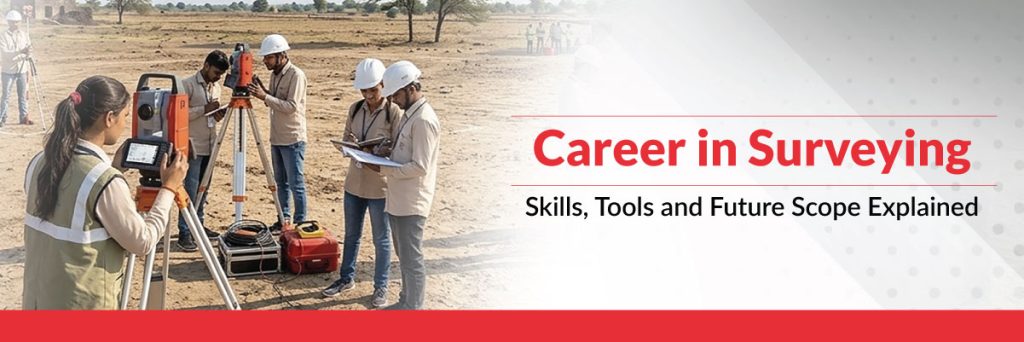
Surveying is one of the oldest and most essential professions in infrastructure development, yet it remains one of the most underrated career paths today. From building smart cities to mapping land boundaries and enabling large-scale infrastructure projects, surveyors play a critical role in shaping the modern world. With rapid urbanization, digital transformation, and the rise of geospatial technologies, career opportunities in surveying are expanding faster than ever before.
What is Surveying?
Surveying is the science of measuring and mapping land, distances, angles, and elevations. It provides accurate data that supports:
- Construction projects
- Infrastructure development
- Land ownership and legal boundaries
- Mining and environmental studies
- Urban planning and smart city initiatives
Without surveying, no major project can begin or be executed accurately.
Why Choose a Career in Surveying?
Surveying offers a unique mix of technology, fieldwork, and problem-solving, making it ideal for individuals who prefer dynamic work environments over desk jobs.
Key Benefits:
- High demand across industries
- Opportunities in both government and private sectors
- Strong career stability
- Exposure to advanced technologies
- Global career potential
With India investing heavily in infrastructure, highways, railways, and urban expansion, the demand for skilled surveyors continues to rise.
Top Career Opportunities in Surveying
- Land Surveyor
Measures land boundaries and prepares site plans for construction and legal documentation. - Geospatial / GIS Analyst
Analyzes spatial data and creates digital maps for planning and decision-making. - Construction Surveyor
Ensures infrastructure projects are executed as per design specifications. - Drone Survey Specialist
Uses UAVs to conduct fast and accurate large-scale surveys. - Hydrographic Surveyor
Maps water bodies and coastal areas for marine and offshore projects
Essential Skills Required for a Career in Surveying
To succeed in surveying, professionals need a combination of technical expertise and analytical thinking.
Technical Skills:
- Knowledge of surveying instruments
- Understanding of geospatial data
- Familiarity with GIS software
- Data analysis and interpretation
Soft Skills:
- Attention to detail
- Problem-solving ability
- Communication skills
- Physical stamina for fieldwork
Professionals who continuously upgrade their skills gain a strong competitive advantage.
Tools & Technologies Used in Modern Surveying
Modern surveying has evolved into a technology-driven field.
Key Tools Include:
- Total Stations for precise measurements
- GNSS/GPS systems for positioning
- Auto Levels for elevation measurement
- Drones for aerial mapping
- Laser scanners for 3D modelling
Companies like Lynx – Lawrence & Mayo provide industry-grade equipment that ensures accuracy and efficiency.
Industry Scope of Surveying
Surveying plays a vital role across multiple industries:
- Infrastructure and construction
- Real estate and urban planning
- Mining and oil exploration
- Railways and highways
- Environmental and agricultural mapping
- Smart cities and GIS projects
With initiatives like Digital India and Smart Cities Mission, the importance of surveying continues to grow.
Future of Surveying Careers
The future of surveying is driven by innovation and technology.
Emerging Trends:
- 3D mapping and digital twins
- AI in geospatial analysis
- Increased use of drones and robotics
- Cloud-based data processing
Surveyors are evolving into data-driven professionals contributing to smarter infrastructure planning.
How to Start a Career in Surveying
To begin a career in surveying:
- Pursue a diploma or degree in civil engineering or surveying
- Gain certifications in GIS and remote sensing
- Get hands-on training with surveying instruments
Practical experience is key to building a successful career.
FAQs: Career in Surveying
1. Is surveying a good career in India?
Yes, surveying is in high demand due to rapid infrastructure and urban development.
2. What qualifications are required for surveying?
A diploma or degree in civil engineering, surveying, or geospatial sciences is typically required.
3. What skills are important for surveyors?
Knowledge of instruments, GIS software, data analysis, and attention to detail are essential.
4. What tools are used in surveying?
Total Stations, GNSS systems, Auto Levels, drones, and laser scanners are commonly used.
5. What is the future scope of surveying?
The field is growing with advancements in AI, drones, and 3D mapping technologies.
6. Where can I find reliable surveying instruments in India?
Professionals and institutions can source high-quality equipment from trusted providers like Lawrence & Mayo (Lynx – Lawrence & Mayo), known for supplying precision surveying instruments and technical support across India.
Conclusion
Surveying is no longer just about measuring land, it is about building the foundation of modern development. With strong demand, evolving technologies, and diverse opportunities, it offers a future-ready career path. Whether you are starting out or looking to upskill, surveying provides a stable and growth-oriented profession. For professionals seeking reliable and advanced solutions, Lawrence & Mayo continues to be a trusted name in precision instruments and expertise.