
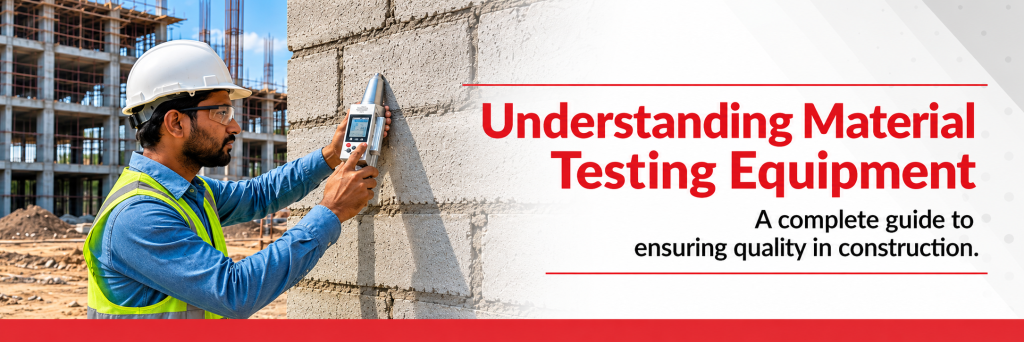
Construction quality depends not only on design and workmanship but also on the quality of the materials used. From concrete and cement to soil, aggregates and bitumen, testing helps ensure that construction materials meet required performance and quality standards.
Modern material testing equipment enables engineers and quality control professionals to evaluate materials accurately and make informed decisions throughout a project.
What is Material Testing Equipment?
Material testing equipment is used to evaluate the physical and mechanical properties of construction materials. It helps determine whether materials are suitable for their intended applications and meet required specifications.
Commonly tested materials include:
- Concrete
- Cement
- Soil
- Aggregates
- Bitumen and asphalt
Why is Material Testing Important?
Testing construction materials helps improve quality, safety and reliability while reducing the risk of defects and costly rework.
Key benefits include:
- Ensuring material quality and consistency
- Evaluating strength and durability
- Supporting construction safety
- Identifying potential material issues
- Improving quality control
- Reducing rework and project costs
Accurate test results provide engineers with valuable data for making better construction decisions.
Common Material Testing Equipment
Different construction materials require different testing methods and equipment.
Concrete Testing Equipment
Used to evaluate properties such as concrete strength and consistency, helping determine whether concrete meets project requirements.
Cement Testing Equipment
Used to assess properties such as consistency, setting time and strength.
Soil Testing Equipment
Helps evaluate soil properties such as density, moisture and compaction, which are important for foundations, roads and infrastructure projects.
Aggregate Testing Equipment
Used to assess properties such as grading, strength and durability of aggregates used in concrete and road construction.
Bitumen and Asphalt Testing Equipment
Helps evaluate the properties and performance of materials used in road construction and transportation infrastructure.
How to Choose the Right Material Testing Equipment
Choosing the right equipment depends on the material, testing requirements and application.
Consider:
1. Testing Requirements
Identify the material and specific properties that need to be tested.
2. Accuracy and Reliability
Choose equipment capable of delivering consistent and reliable results.
3. Ease of Operation
User-friendly equipment can improve laboratory efficiency and reduce operational errors.
4. Durability
Equipment should be suitable for regular use in construction laboratories and testing facilities.
5. Calibration and Support
Regular calibration and technical support are important for maintaining testing accuracy.
Applications of Material Testing Equipment
Material testing is widely used in:
- Building construction
- Roads and highways
- Bridges
- Railways
- Airports
- Industrial infrastructure
- Civil engineering laboratories
- Construction quality control
Role of Material Testing in Construction Quality
Material testing allows engineers and quality control teams to verify whether materials meet project requirements before and during construction.
By identifying inconsistencies early, testing can help minimise material-related problems, reduce rework and support better project outcomes.
FAQs: Material Testing Equipment
1. What is material testing equipment used for?
It is used to evaluate the quality, strength, durability and other properties of construction materials.
2. Why is material testing important in construction?
It helps verify material quality, improve safety and reduce the risk of construction defects and costly rework.
3. What materials can be tested?
Common materials include concrete, cement, soil, aggregates, bitumen and asphalt.
4. How do I choose the right material testing equipment?
Consider the material, required tests, accuracy, ease of operation, durability, calibration and technical support.
5. Where is material testing equipment used?
It is commonly used at construction sites, civil engineering laboratories, testing facilities and infrastructure projects.
6. Where can I find material testing equipment in India?
Lynx – Lawrence & Mayo supplies material testing equipment and civil engineering instruments for professional applications across India.
Conclusion
Reliable material testing equipment plays an important role in maintaining construction quality, safety and performance. By selecting the right testing solutions, engineers and quality control professionals can make informed decisions and support more reliable construction outcomes.
About Lynx – Lawrence & Mayo
Lynx – Lawrence & Mayo is a trusted supplier of surveying tools, civil engineering equipment, laboratory microscopes and instruments, and scientific instruments in India.
Serving professionals across infrastructure, construction, healthcare, research and education, Lynx – Lawrence & Mayo offers solutions including Total Stations, GNSS systems, Auto Levels, drones, material testing equipment, laboratory microscopes and other scientific and analytical instruments.
With a strong presence across Mumbai, Bengaluru, Chennai, Kochi, Guwahati, Goa, Ahmedabad, Kolkata, Nagpur, New Delhi, Bhubaneswar, Secunderabad, Pune and Visakhapatnam, Lynx – Lawrence & Mayo supports projects and institutions across India.
For enquiries, call +91 74000 55001 for scientific instruments and +91 98202 39443 for surveying instruments.
Explore the complete range at www.lynxinst.com.